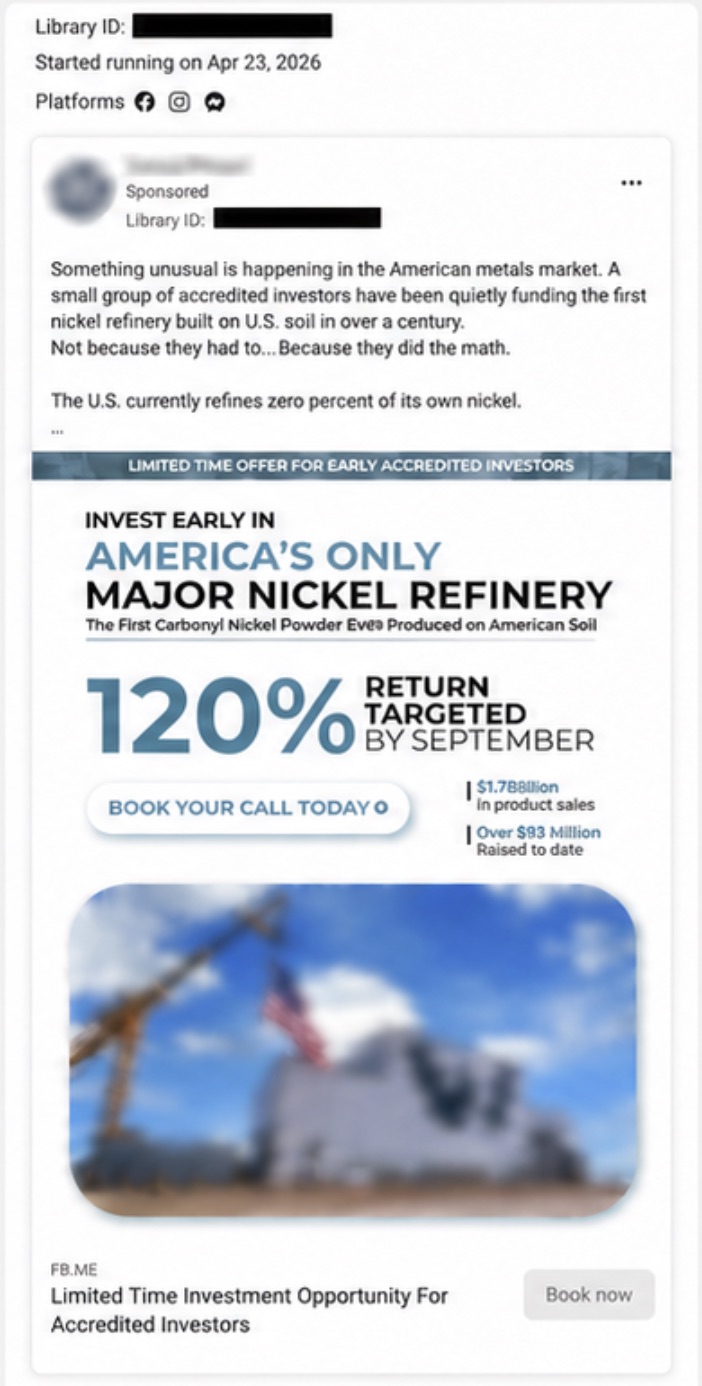
Direct to booking
Book the call now.
Thirty minutes with a stranger, requested before they know whether it is worth it.

Investor acquisition infrastructure for Reg D 506(c) and Reg A+ issuers raising $1M and up. We build the system between the click and the commitment.
Rule 506(c) let issuers advertise to people they have never met. It did not give anyone a way to turn a stranger into an investor.
Almost every campaign we look at lands in one of three places.
Thirty minutes of a stranger's time, requested on first contact.
Accreditation and a hundred page document, from a cold click.
Full navigation, other business lines, no path to anything.
Advertiser identity, Library ID, and exact domain are redacted. Useful copy, figures, dates, structure, imagery, and calls to action remain visible.
Thirty minutes with a stranger, requested before they know whether it is worth it.
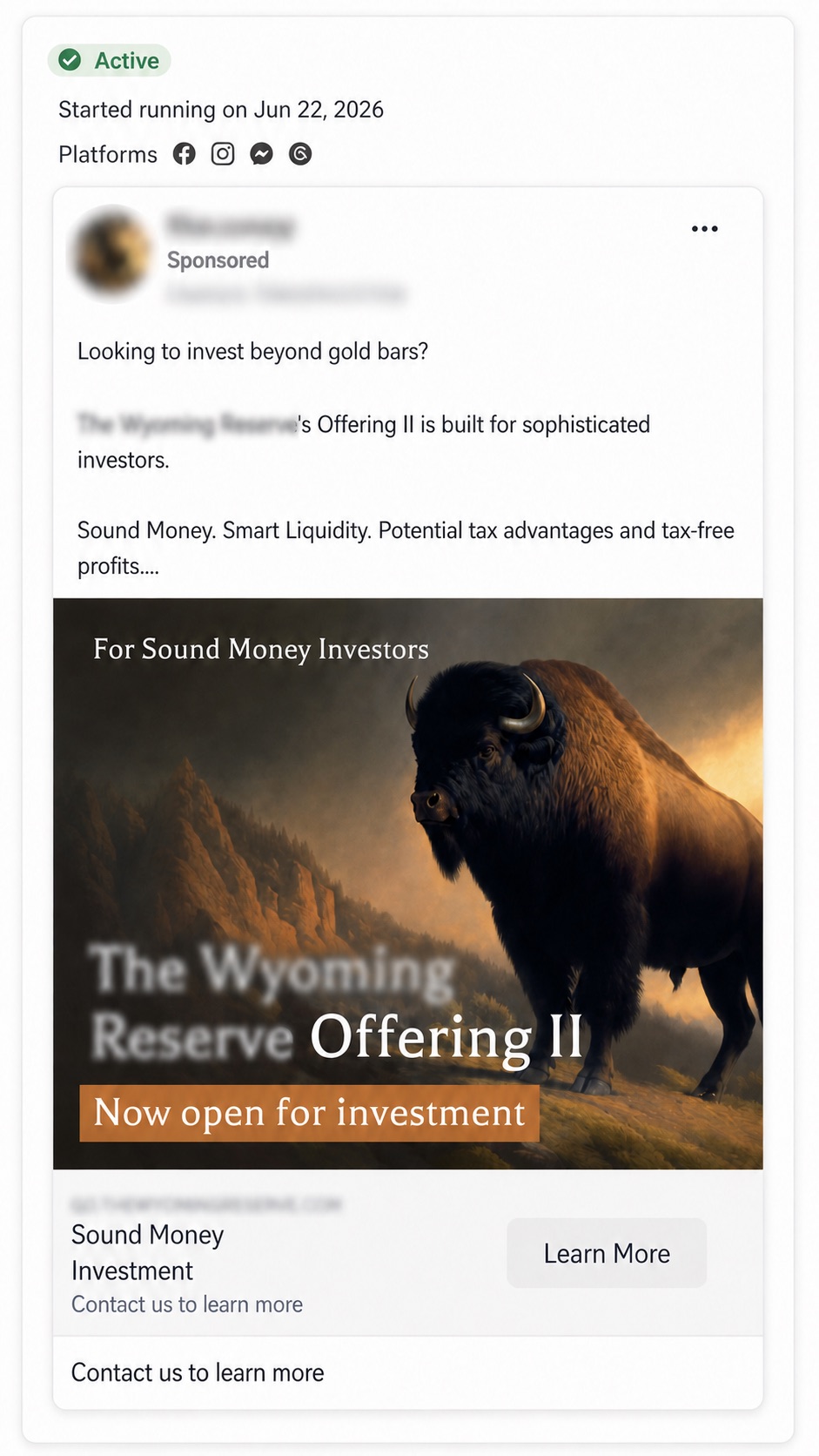
First-time investors in this market typically take weeks to reach a commitment. This page asks for the decision in a single visit.
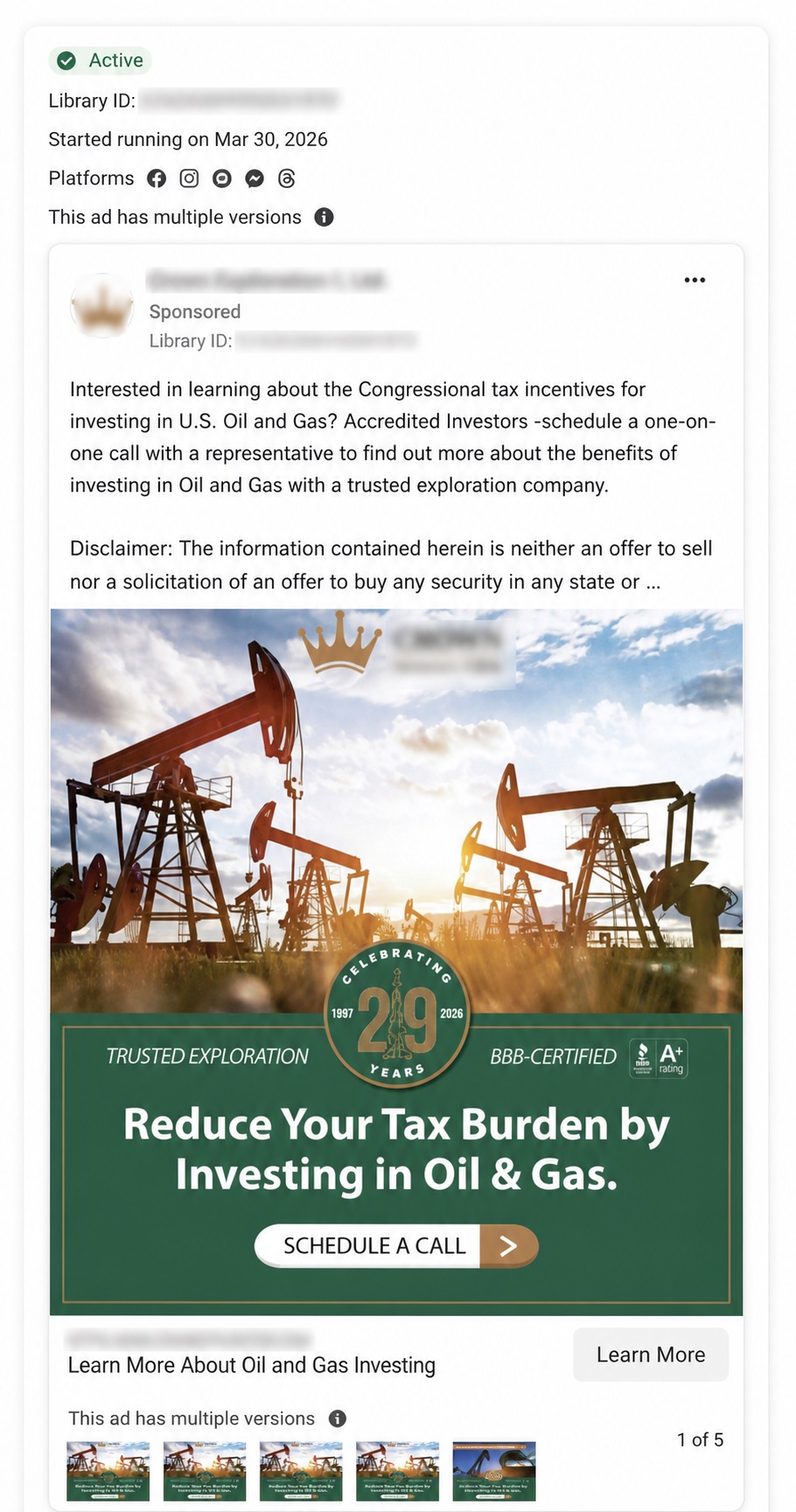
Navigation, other business lines, and no guided next step. Every link is a way out.
The first click does not prove intent. The destination has to receive the level of trust the visitor actually has, then create the next one.
This is the Improvised Raise. Ads, LinkedIn posts, manual outreach, a landing page, a deck, an inbox, a spreadsheet and a calendar link. Each one built or bought separately, with no single investor journey and nothing measured end to end.
Keep reading if you would rather see the whole picture first. The page is here either way.
An accredited investor moves the same way every other buyer moves. Attention, then interest, then investigation, then enough trust to spend real time, then a decision. That takes repeated contact over days and weeks.
Right now the middle between the click and the commitment is empty. There is nothing there to hold the people who are not ready yet, so they leave, and nothing brings them back.
That distance is the Capital Conversion Gap. The space between generating investor interest and turning it into a qualified, funded investor.
A 2026 guide for first time 506(c) investors estimates two to six weeks for $25,000 to $100,000 commitments and 60 to 120 days for commitments of $250,000 or more. Check size, sponsor history, diligence, and onboarding all change the window. Source
Accredited investors are a narrow audience, so you pay more to reach them than almost anyone else you advertise to.
Picture this: somebody clicks on your ad. They arrive on a page that asks them to book or to invest, and offers no other way to raise their hand. They are not ready to do either, so they just leave, and you never learn who they were.
But you already paid for that click. Had there been somewhere to leave their details, they might be on your list, and reaching them again next month would cost you nothing. Instead you buy the same click a second time, or you lose them for good.
Then the raise runs longer. Another month of your team's attention. Another month of holding costs on whatever the capital was meant to fund. Another month explaining to the investors who did come in why the round is still open.
None of that arrives labelled as a marketing problem. It arrives as a raise that is taking longer than it should.
The Digital Roadshow Engine occupies the distance between the click and the booked capital conversation. Capture, qualification, presentation, follow-up, nurture, and the instrumentation that tells you which of it is working.
Which pieces your raise actually needs, and in what order, depends entirely on what is leaking. That is not something to guess at from the outside, and it is what the diagnostic is for.
It starts with knowing exactly who this offering is for. Not every accredited investor. The ones whose goals line up with what this deal actually does. That one decision stops you paying to reach people who were never going to invest in it.
Then the ad speaks to that person, and it sends them somewhere they can learn more instead of somewhere they have to commit.
They give you their details, and that is what lets you keep going. More of the story. Why this deal exists, why it is built this way, and why it is different from the last three they looked at. The questions, the objections and the things people wrongly assume about this kind of investment all get handled here, before anyone gets on a call.
By the time someone books, they know the thesis, they have met the team, and the obvious questions are behind them. They arrive informed, and the conversation starts at the real questions.
Your team stops answering the same five things on every call. And you can see where every interested person stands instead of guessing.
All of it rests on one decision, made before a single piece gets built.
It tells you who is allowed to invest. It tells you nothing about who wants to, what they are trying to do with their capital, or whether they are anywhere near ready to hear about a deal.
Most 506(c) advertising names the legal category and stops there, as though qualification were the same thing as an audience. Accreditation is the floor a person has to clear. It is not the target you are aiming at.
There is a path a person actually walks before they write a check. We mapped it.
Status quo
“My current investment approach is fine.”
Portfolio tension
“Something is not giving me what I want.”
Strategy awareness
“Private investments may be an option.”
Investment thesis
“This category may fit my goals.”
Deal discovery
“This specific opportunity could fit.”
Due diligence
“Can I trust the team, proof, risks, and terms?”
Decision
Invest, investigate further, or pass.
Investors may enter, pause, compare, or move backward.
“Invest in our fund” is written for someone who already believes private placements belong in their portfolio and is now comparing specific deals. Everyone else clicking the ad is at stage one, two, or three. They have not decided they want this kind of deal at all.
Which stage your traffic is actually in is what the diagnostic determines, and it decides what gets built first.
The Form D is in. The deal is ready. There is no funnel, no list, and no plan for building either. The clock on the raise already started.
They run social, the blog, and the newsletter for the operating business. Now they have been handed a capital raise. They are learning securities marketing on live ammunition, and the exposure sits with you.
Experienced, capable, and already at capacity on everything else the business needs. The raise becomes the thing that gets worked on at night.
This is a custom build and surgical install, not a generic template or a retainer that swallows your department.
We build around your raise, install the roadshow, and train your team on how it works, what to do, and what must never be done inside the exemption. Then we hand over a system they can run.
If the team needs another pass, we stay available for focused support. Hand over does not mean left hanging.
Rule 506(c) allows broad solicitation. It does not relax the requirement that offering communications be accurate, supportable, and not misleading. If a registered investment adviser is involved, additional advertising rules may apply.
The mechanics still transfer: sequencing, objection handling, list building, follow-up, and measurement. The proof has to be verified, fairly presented, and cleared by the issuer's securities counsel.
Examples, not a legal checklist. What can appear depends on issuer and adviser status, source substantiation, and counsel approval.
Same architecture. Different proof set.
Neither number came from a clever ad. They came from structure. The right sequence. Infrastructure that did not leak. A presentation that builds confidence by delivering the right proof in the right order.
And above all, knowing which information to pull forward and put in front of the person deciding.
That last one is the skill that matters here. In a consumer launch it means surfacing the right proof for a buyer. In a 506(c) raise it means surfacing the right proof for an accredited investor. Prior offerings. Capital returned. Distributions paid. Coinvestment. Patents. Operating history. Most issuers have it. Almost none have it organized, sequenced, and placed where it does work.
Both figures are revenue divided by documented advertising spend. Both were consumer launches, not capital raises. They are evidence of what the system does when it is built properly. Nothing here promises or projects any result in a securities offering.
Your marketing infrastructure does not start from a blank page. We have taken live investor funnels apart stage by stage, so you begin from a structure that is already working, adapted to your offering.
Live capital funnels, reverse engineered. Eight stages each. $1.235B+ Capital reported sold, raised, or funded across the sponsor research behind the library. Each funnel contributed a different architecture, and the differences between them are what the library is built from. Latest public Form D and Form D/A filings reviewed September 2026
We track what we would never copy, and why. Some tactics may generate leads while creating unnecessary compliance risk. Keeping that record helps us build from what works without repeating what should stay out.
It is a separate record applied across all eight stages, not a ninth stage.
14 years, Intel Fab 17. Senior Manufacturing Operations Manager. 250 technicians and 10 managers on a line that never stops. 450 plus factory-wide improvements, one of them recognized with a People’s Choice award at Intel’s global manufacturing conference.
2014, Startup Dad HQ. A podcast built while still working the fab. Over a million listeners across 114 countries. Number one in iTunes New and Noteworthy in Business.
2016, webinar production. Live events for doctors, coaches, authors, speakers and online business owners. Where the presentation itself had to do the convincing.
2017, Integrator & Co. A digital marketing firm. Seven years, fourteen verticals, more than $40M in tracked client revenue. A team of media buyers, copywriters and designers. Acquired December 2024.
Chief Marketing Officer, a capital formation platform. Hands-on work in Regulation Crowdfunding, and a year taking Reg D and Reg A+ offerings apart one funnel at a time.
2026, Lattice & Co. Division I, the Roadshow Engine. Investor acquisition infrastructure for Reg D 506(c) issuers, built with my sister Casey.
“You can’t connect the dots looking forward. You can only connect them looking backwards.” — Steve Jobs
This is one of my favorite quotes. Looking at my body of work over the last 25 years, it could seem disjointed. Every piece of it set the stage for this.
14 years managing people on a high-volume manufacturing floor that runs 7 days a week, 365 days a year, from individual contributors up to managers. 2 years building an audience from nothing and reaching more than a million people.
7 years running my own digital marketing firm, learning and dissecting human psychology when it comes to an offer. How to position it, how to make it compelling, and how to put it in front of the right person at the right time. Lastly, 2 years inside a capital formation company, learning the ins and outs of capital formation, the SEC rules and regulations, the do’s and don’ts, and where nothing goes out until compliance and securities counsel have seen it.
I tell you all of this so you know what you are getting. After 10 years working with founders, the thing I understand best is that you do not need another person to manage. You are trying to build and scale. Outside help that turns into another standing meeting is not help.
We come in as the expert, execute on your vision, and support the team you already have rather than add to their plate. Your time goes in at the start, at a checkpoint in the middle, and at the handover.
Not a broker dealer. No investor solicitation, no securities sold, no compensation tied to capital raised.
Not an investment adviser. No advice on the merits of any offering.
Not securities counsel. Lattice does not author offering terms, projections, or returns. Your numbers come from your documents and carry your basis of calculation.
Not an agency. The deliverable is a system, not campaigns.
Every public-facing asset routes to your securities counsel before it goes live. That is in the engagement, not offered as a courtesy.
A short form gives Joel the raise context before the conversation begins.
Book a thirty minute Zoom conversation directly with Joel.
We look at where the raise stands, what is already built, and where attention or trust is leaking. If there is a fit, the next step is the Business Intensive, a paid diagnostic. If there is not, you hear it on the call.
Stop improvising the raise. Build The Digital Roadshow.
Thirty minutes. Zoom. Bring your numbers if you have them.